
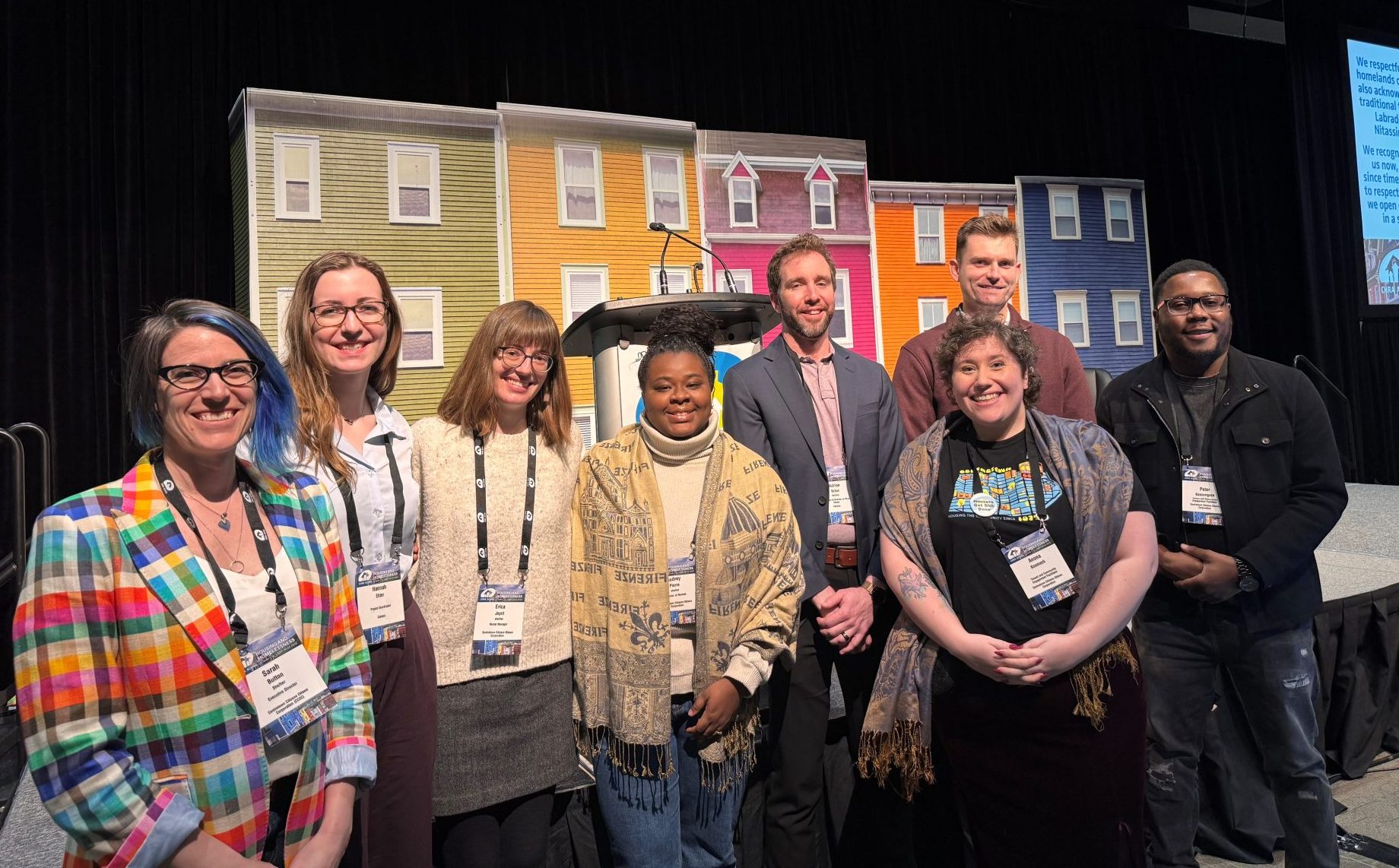
8 members of the CCOC and Cahdco team traveled to St. John’s, Newfoundland in April for the Canada Housing Renewal Association (CHRA) annual congress. CHRA is the national membership organization for non-market housing providers, and their annual gathering is an opportunity for us to hear from our peers about trends, challenges, and opportunities from coast to coast to coast. It was a busy agenda, featuring keynote speakers highlighting the important links between housing and health, panel discussions on energy efficiency and supporting tenants through better systems, and workshops about partnerships and what comes next for the National Housing Strategy.
After the conference, CCOC and Cahdco attendees met for lunch at the office to debrief on the experience, what we learned, who we met, and what’s sticking with us a few weeks on.
The constant presence was Build Canada Homes (BCH). BCH emerged as a new federal funding partner in 2025, and we still don’t have a lot of details in terms of what BCH will fund, or how. We know BCH wants to change the way housing is financed, but the team observed a tension in the room: BCH is asking the housing sector to trust them with a new funding model, but it’s hard to trust them when they have so few answers yet. Extending that trust requires us to hold a lot of risk in the meantime! But there are good signs: BCH keeps listening to the sector, asking us what we want and how we would like them to operate, and they do (so far) appear to be prioritizing non-market housing.
There’s also a tension between policy and politics. Measuring the impact of non-market housing for communities and individuals is really important, but the emphasis on doing so to attract private investment felt sometimes at odds with the clear need for greater political will to address homelessness and supportive housing, especially.
CCOC’s place in all this is complex. We are among the most flexible and adaptable non-profits around, and our mixed-income model allows us to meet our mission and fit into BCH’s affordability framework…but it’s not a perfect match. As BCH and others emphasize the importance of “crowding in” capital, we’ll likely need to look at different sources of financing for our new developments. There’s a risk our relationships with our community could be strained by some of these increasingly necessary ways forward.
Alongside these big-picture thoughts, the team also shared some specific ideas that are sticking with us:
- Digitization has made some things harder, and system design issues may be showing up as capacity challenges: adding people might not improve service if the system doesn’t change.
- Supporting tenants with more complex needs might require us to think creatively about transferrable employment skills from unexpected sectors.
- In a rapid growth context, don’t let the perfect be the enemy of the good. Sometimes you have to keep moving and be open to incremental revisions as you go.
- Finally, a big takeaway from a major research paper that will be released in June is this: the greatest impact for affordable housing comes from a dual focus on preservation and development.
As we wrapped up our discussion, the team agreed that it’s really important for us to continue to be in the room at these kinds of events. The decision-makers who shape policy, new programs, and creative solutions are in attendance, and a lot of folks across the country look to CCOC and Cahdco for leadership and insight: people trust us because we’ve survived and thrived through decades of change, and they believe we have solutions they can learn from.

Our Updates, Your Inbox.
Sign up for the NewsNotes and we’ll deliver the latest news and information about CCOC directly to your inbox! No spam, ever.
You are already subscribed to our NewsNotes!
